Skip to content

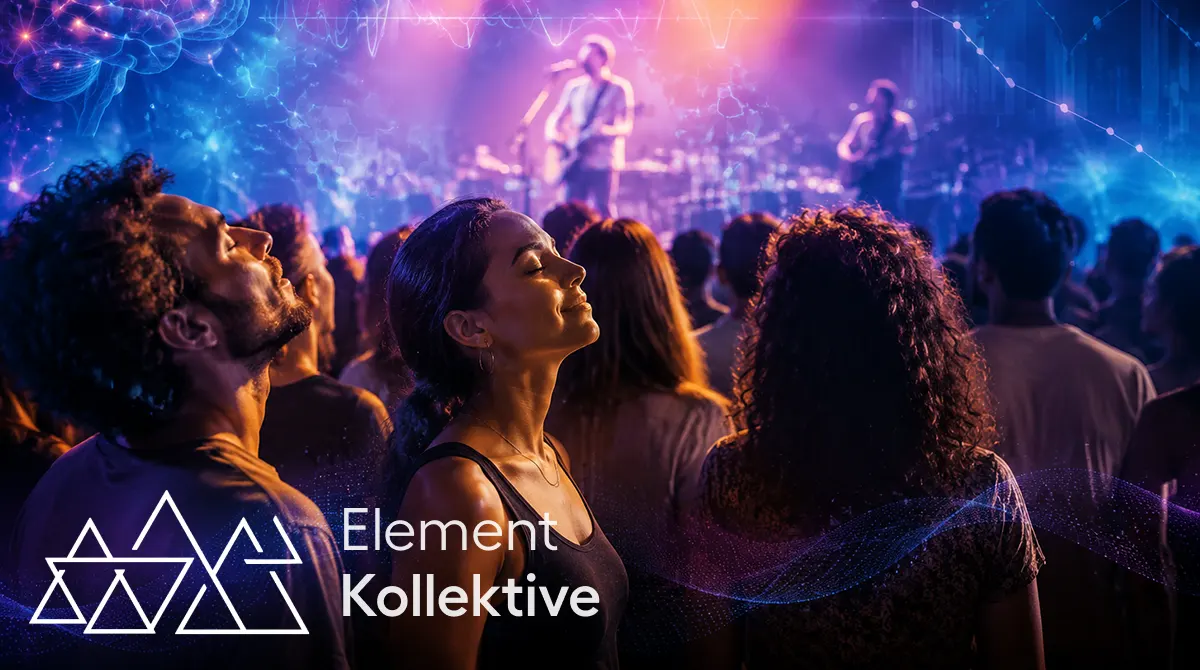
Live music has been present throughout civilizations and cultures across the globe for thousands of years. Whether as forms of ethnic ritualistic music, live chamber music, or even today’s massive music festivals. People have gathered to enjoy listening to music for a long time. You may ask yourself: ‘Why not just listen to recorded music alone?’ This article is aimed at answering that question by showcasing the profound benefits of live music.
Listening to music itself has long been associated with stress reduction, improved mental and emotional well-being. But live concerts offer music listeners something that recorded music lacks: shared emotional experiences, social bonding, a spontaneous nature, and a feeling of belonging. Recent research and lived experience will show how these unique qualities affect us so deeply.
In this article we’ll explore:
- Whether Live Music Affects Us More than Recorded Music
- How Concerts Improve Mental Health and Cortisol Levels
- Whether Concerts Cause Panic Attacks and How to Overcome Them
- How to Get the Most out of Concerts
Does Live Music Affect Us More Than Recorded Music?
Listening to recorded music and watching concerts online has become more accessible and cheaper than ever, people still enjoy seeing live concerts. According to a 2025 study from France titled “Watching live performances enhances subjective and physiological emotional responses compared to viewing the same performance on screen”: “Live performances elicit stronger emotional and physiological responses compared to their recorded counterparts, even when viewed in identical environmental conditions.” The results also suggest that the presence of live performers fosters a deeper emotional connection and heightens engagement. If live performances evoke stronger emotional responses than recorded music, the question becomes whether those responses translate into measurable biological changes. [1]
Can Live Concerts Decrease Cortisol Levels?
Yes they can but the effect depends on several factors. Musical preference, genre and the concert environment or even the individual’s emotional state can all impact how the body responds to the experience. 2015 study from London, UK titled “Attending a concert reduces glucocorticoids, progesterone and the cortisol/DHEA ratio” reports: “our results suggest that attending a live performance leads to lower secretion of glucocorticoids and a reduced cortisol/cortisone ratio, indicating lowered biological stress.” However the researchers also admitted to the limitations of the study. It was conducted in an uncontrolled environment due to the nature of the research itself, in a concert hall instead of the laboratory. It also relied on replication to confirm findings instead of using a big number of participants. This study focused specifically on the effects of relatively calm classical music. As a result the findings cannot conclusively be generalized to every concert or every music genre.[2]
How Do Concerts Reduce Stress?
Concerts may reduce stress because listening to music in the presence of others enhances the experience. A German study by Linnemann, Stahler, and Nater titled “The stress-reducing effect of music listening varies depending on the social context” argues: “Music listening in the presence of others enhances the stress-reducing effect of music listening independently of reasons for music listening.” The shared social experience and the sense of community that concerts foster may be the reason for why concerts help reduce stress.[3]
Can Live Concerts Improve Mental Health?
Live concerts offer opportunities for an individual to experience social bonding, shared emotional experiences, and a sense of belonging which have been associated with mental well-being. A 2024 study from the University at Buffalo,NY, titled “Let the Music Play: Live Music Fosters Collective Effervescence and Leads to Lasting Positive Outcomes” quotes: “We find that live music events are not merely fun but can have lasting, meaningful impacts for those who attend.” Collective Effervescence (CE) is a psychological phenomenon describing the heightened sense of unity that emerges when a group of people gather for a shared purpose. These findings suggest that the benefits live concerts offer extend beyond the music itself. The social bonding, the synchronized body movements and emotionally connecting with the crowd and the performers help explain why people feel energized and refreshed after live concerts.[4]
A recent Australian review titled “The unifying power of live music events: A systematic review of social outcomes for audience members “ looked at 56 different studies about live events and reached a similar conclusion. It found consistent evidence that concerts promote social connection, belonging, and collective emotional experience that extend beyond the music itself.[5]
Author’s note:
“As a former touring musician I’ve experienced live concerts from both sides of the stage. Something that research can’t capture is the feeling of anticipation before the show. From the moment I buy tickets to go to a show with my friends, the anticipation factor kicks in. Concerts feel less like typical nights out and more like rituals.
One thing that never ceases to fascinate me about live shows is the spontaneous nature of them. Even after months of rehearsals, anything can happen. Something can go wrong with the sound, the performance may take an unpredictable turn or you get to witness memorable moments, even a proposal from the stage. If you’re lucky enough you can find yourself catching the drumstick or the guitar pick as a memento at the end of the set which will always remind you of good times.”
Can Concerts Trigger Panic Attacks? Which Type of People are Susceptible
For people struggling with anxiety disorders, the concert going experience may be challenging and can trigger panic attacks. Concerts are loud, crowded and unpredictable environments which can all trigger people struggling with specific mental health disorders. The National Health Service notes that avoiding places or situations that may trigger obsessive thoughts is a common feature of OCD. As a result, the inherent features of concerts which include large crowds, loud music, sensory stimulation and the inability to easily leave may distress people with OCD, anxiety disorders or similar conditions.[6]
Concerts can also be too challenging for people suffering from agoraphobia. The NHS defines agoraphobia as “the fear of being in situations where escape might be difficult or that help wouldn’t be available if things go wrong.” This can make large venues, tightly packed crowds, or unfamiliar environments particularly stressful for some individuals.[7]
For some people, concerts may be fully inaccessible, Individuals with enochlophobia (fear of crowds) or ochlophobia (fear of mob-like crowds) may find even everyday environments, such as busy shopping centres or grocery stores, distressing. Those types of individuals may avoid concerts entirely. But for some relatively milder disorders there may be practical ways to make live events more manageable.
Can People with Anxiety Disorders Still Enjoy Concerts?
The potential benefits that live concerts offer might outweigh the negatives for people with anxiety disorders and OCD.
Some practical steps to reduce triggers that could soften the experience:
- Go with someone supportive: Going to a show with someone you trust could give you peace of mind that they can take care of you if something goes wrong. Enjoying the experience with them is an added bonus.
- Charge your phone: Having a fully charged phone will assure you that you can call for help in case of emergencies.
- ave some small snacks ready with you: If the venue doesn’t serve food already, you may be able to get away with having something sweet or salty like chips or protein bars with you. You won’t worry about when your blood sugar or blood pressure drops at the show. Having some water is also a good idea for dehydration.
- Get to the venue early: If you get there early, you won’t have to worry about missing anything. Also you will get accustomed to the environment before it gets crowded.
- Notice the venue’s layout: When you get to the venue, take a mental note of the exits and bathrooms. You can even buy tickets near the exits in advance. Be mindful of standing or being near the rails or walls since those are the places you could feel trapped.
- Use ear protection: While ear protection will also protect your ears, the loud noise won’t feel as overwhelming if you use proper earplugs.
- Learn about breathing techniques: If you notice a panic attack creeping in, you can use controlled deep breathing to stay mindful of the event.
Author’s Note:
‘As a musician with live experience, I thought it worth mentioning that the fear of live shows is not a one-way-mirror. I’ve been there, I still have the jitters before performing, so do many performing musicians that I know personally. You’d be surprised at how many iconic musicians including Adele, Eddie Van Halen, and Ozzy Osbourne have suffered from stage fright. Taking this into account, might help performers be more relatable and human to people who experience uneasiness during concerts.’
How to Get the Most Out of a Live Concert? Pro Tips
One of the biggest things that can enhance your live show experience is going to the show with your friends. Going to concerts with people who share your passion for the artist or genre often makes the experience feel more memorable and emotionally meaningful.
With that being said, here are some tips and tricks that seasoned concert goers suggest:
- Familiarize yourself with the artist and genre: While some people prefer to be surprised, it’s common practice to search about the artist and the genre in general before the show. It makes the experience feel more intimate and personal if you know the artist.
- Treat it as a ritual, not a normal outing: If you treat it like a ritual, it becomes a ritual. Schedule your ride to and from the venue in advance so you’ll be there on time.
- Listen to the setlist if available: Listening to the setlist in advance can make you more prepared for the show. It makes the choruses hit harder and you may be able to sing along. Your body may be even more accustomed to the rhythm while moving.
- Wear ear protection: It’s a fact that concerts are loud experiences.Wearing high quality ear protection will reduce volume and not sacrifice the sound quality. By wearing ear protection, you will protect your ears and be able to enjoy live shows for a long time.
- Learn the crowd traditions: Dedicated fans of artists usually have traditions at the live shows. They include chants, synchronized clapping, dance moves, mosh pits, crowd surfing, lights at ballads, etc. Being a part of those traditions may deepen emotional connection. The crowd is bigger than the sum of its parts.
- Put your phone away: While capturing some videos or pictures on your phone is perfectly fine, spending the whole concert behind your phone takes away from the experience. As mentioned before, being engaged and immersed in shared experiences, contributes to stronger social connections and emotional memories.
- Give the opener a shot: While you may go to the concert to see your favorite artist, openers are usually picked to complement the big artists before the show in one way or another. There is a reason they are able to play alongside your favorite artist. You might even become a fan.
- Don’t worry too much about your spot: Pick a place where you’re comfortable and can immerse yourself in the experience. If there’s moshing or too much movement that makes you uncomfortable with it, move to a spot that will feel right for you.
- If someone falls down, help them up: It’s proper etiquette to look after fellow concert goers in case they trip or fall down. Help them back up.
Author’s Note:
“Personally, picking the perfect wardrobe for the show in advance is something I enjoy. I’ve lost count of how many times of the number of conversations that started simply because someone recognized the band on my shirt. In many music communities, clothing is more than just fashion, it’s a conversation started and a statement about identity. Wearing a band’s merchandise or clothing associated with a genre creates an immediate sense of familiarity among fans.”
Which Types of Concerts Have a More Calming Effect?
There isn’t one genre that is considered to be better at inducing calming effects. The most recent research points to personal preference, emotional connection, and familiarity with the music being more important than the genre.[8]
While classical music has been the subject of many stress-related studies, it does not mean that it’s more calming than other genres like pop, rock, jazz, and metal. Most studies have focused on classical music so evidence for other genres is more limited.[9]
Ultimately the type of concert that is more likely to reduce your stress is often the one that you genuinely enjoy. Emotional connection, familiarity with the artist, and the shared experience of enjoying music with others seems to play a larger role than genre in stress regulation.
With that being said, it’s worth looking into genres that are specifically engineered to induce stress reducing effects like Mantra Music. Mantra Music uses repetitive rhythms and chants to reduce mind-wandering and rumination.
Is Going To Concerts Worth It?
Ticket prices, transportation logistics and personal restrictions are some reasons music listeners state that might be hesitant to go to a concert. For most cases, the upsides of going through the live experience outweigh the downsides. Both research and lived experience show that concerts are good at bringing people together. They invoke a sense of community that few events can rival since musical taste and experience is subjective and deeply personal. While recording and production techniques and quality have drastically improved during the last decades, live concerts, especially when done well, are where you can experience the randomness of life.
We at Element Kollektive proudly host concerts in Vienna that focus on the intimate and mindful side of live music, you can learn more about our live events in our event page.
[1] https://www.sciencedirect.com/science/article/pii/S2667242125001186
[2] https://www.sciencedirect.com/science/article/abs/pii/S0033350615004990
[3] https://www.sciencedirect.com/science/article/abs/pii/S0306453016301767
[4] https://journals.sagepub.com/doi/abs/10.1177/01461672241288027
[5] https://journals.sagepub.com/doi/10.1177/10298649251349703
[6] https://www.nhs.uk/mental-health/conditions/obsessive-compulsive-disorder-ocd/symptoms/
[7] https://www.nhs.uk/mental-health/conditions/agoraphobia/overview/
[8] https://www.frontiersin.org/journals/psychology/articles/10.3389/fpsyg.2013.00511/full