Skip to content

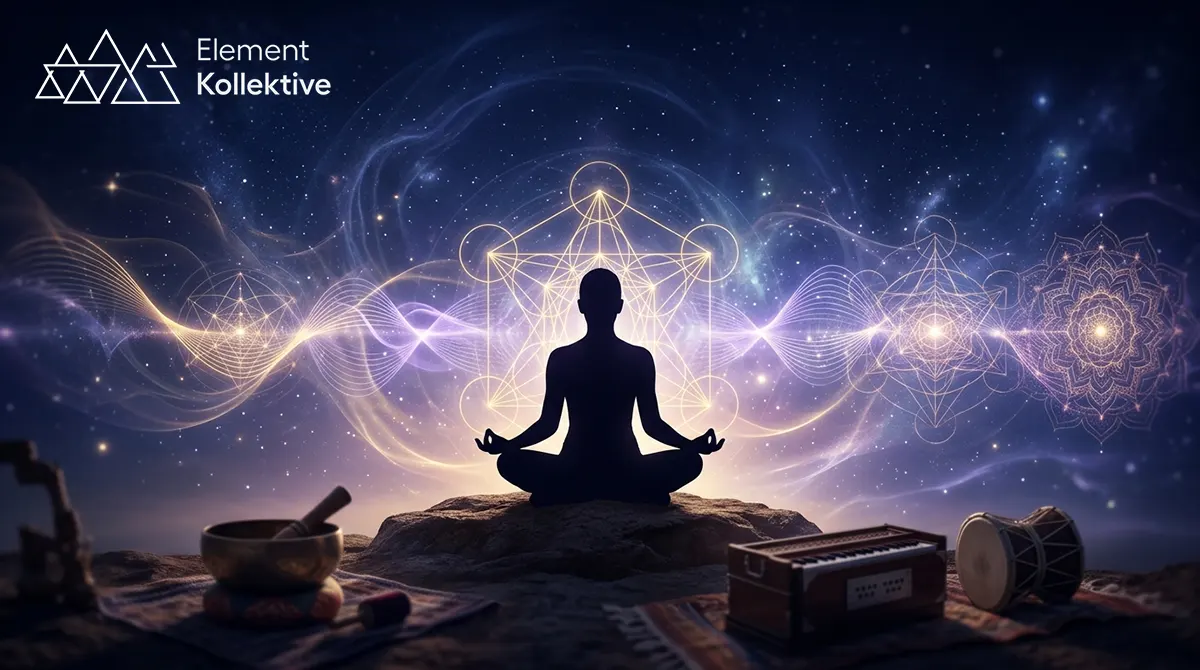
Every culture throughout history has discovered how repetition is a powerful tool to alter the mind. Mantra Music is a three-thousand-year-old musical style that combines repetitive chants, atmospheric and minimal music to create a divine art form. Even now in 2026, mantra music is still associated with mystical experiences and soul healing.
In this article we’ll explore:
Mantra Music’s Origins
What does the term mantra actually mean?
The Encyclopedia Britannica defines the word mantra as a sacred utterance of divine and mystical nature. Its origins are rooted in Asian religions like Buddhism and Hinduism. It can be a syllable, a word or a verse spoken out loud, muttered under the breath or even thought. Buddhist traditions, especially Mahayana and Tibetan Buddhism, considers mantras to be vital in achieving the state of nirvana.
The term “mantra” comes from the Sanskrit root man, to think with the suffix -tra giving the word a sense of instrumentality. In essence it can be translated to “instrument of thought”.[1]
Where did the concept of mantra first originate?
Mantras first developed during the Vedic period of India dating to about 1500–1200 BCE. Vedic religion is considered to be the first layer of Hinduism. Those initial hymns that were chanted more than 3000 years ago are still preserved through the Rig Veda, a series of ten books which are coincidentally the oldest of the sacred books of Hinduism. These early Vedic chanting traditions later became foundational to yoga, meditation, and devotional practices across India.
The concept of repeating mantras or chants can be seen throughout different religions, cultures and traditions across the globe. There is a reason why humans from different walks of life practice it every day. There are various studies that confirm that they have a calming effect on the mind which we’ll explore.
How Mantra Music Works
One of the reasons that mantra music made sense to me personally is that I’m experiencing something similar in everyday life. I often find myself singing the chorus of my favorite songs during car rides alone or with my friends. For a few minutes my usual streams of thought about worries, distractions, and internal monologues fade away and my attention shifts outward. Me and my friends focus on the lyrics we know by heart, the notes, and the rhythm in particular. I’ve experienced something similar but on a bigger scale during concerts where I find myself singing alongside thousands of people. The music stops becoming something I merely observe, it becomes a collective experience that I’m a part of.
Mantra Music operates on the same level but in an intentional, and structured way. By using repetition as the foundation and using predictable rhythms it makes it easier to enter that state more easily. The mantras are not just sounds but meaningful words or phrases that carry divine meaning, inviting focus, contemplation, and reflection. With the combination of rhythm, repetition and meaning, mantra music is able to quiet internal mental noise. There are almost limitless options of mantras to choose from but finding your own personal favorite mantra makes the experience even more significant spiritually.
Mantra Music’s Influence on the Mind and The Body
How does mantra music boost your mood?
Listening to music increases the levels of neurohormones that influence pleasure and reward, mood regulation, and social bonding, which likely leads to increased positive mood.
A 2021 study from Macquarie University, Australia titled “Rhythmic Chanting and Mystical States across Traditions”, reports: “Synchronous music activities lead to neurohormonal changes, such as increased dopamine, serotonin and oxytocin.”
This is especially true for mantra music traditions that have a call-and-response nature like Hare Krishna, Hindu and Kirtan where participation is a vital part of the experience. Those practices include a conversational style of chanting that promotes moods of joy, ecstasy, peace and tranquility. However, the positive benefits depend somewhat on personal disposition and spiritual beliefs. [2]
How mantra music reduces stress and anxiety
By focusing on the repetitive chanting of mantra music, listeners can sever the cycle of overthinking and rumination.
A 2024 study on Springer titled “Exploring the Physiological and Psychological Effects of Group Chanting in Australia: Reduced Stress, Cortisol and Enhanced Social Connection”, revealed that “A short group chanting intervention, whether vocal or silent.
decreased stress (cortisol levels), anxiety and increased altruism.” The researchers also found that participants reported a greater sense of social connection after chanting sessions. However, it’s worth noting that not every chanting style has the same effect on each person. It’s a highly personal practice rather than a fixed way to find peace.[3]
In 2016 researchers from Cornell University published a paper with the title “Functional neuroanatomy of meditation: A review and meta-analysis of 78 functional neuroimaging investigations”. The study found that mantra music engages the brain networks involved in attention regulation while reducing mind wandering and rumination. Mantra music and especially styles that have vocalized call-and-response style traditions incorporated within their structure, give the mind something singular to focus on which helps break the cycle of constant overthinking and rumination. It also helps people to ground themselves in the present instead of thinking about the past or the future. [4]
How Mantra Music Improves Mental Clarity and Focus
How Listening to Mantra Music Gives You Inner Peace
Your Personal Mantra Music Journey
- Turn off your digital devices or put them on do not disturb mode
- Choose a time where you won’t have external distractions
- Choose a quiet and comfortable space
- Close the shades and turn off the lights to create a dim atmosphere
- Play the music and focusing on the rhythm and your breathing
- (Optional) Use Incense or scented candles to set up the ambiance
People usually report that listening to mantra music first thing in the morning or at night before sleep is the ideal time. I personally find that listening and engaging with mantra music works best right after a long shift. It helps sever the connection of thoughts that have piled up during work hours.
During initial listening sessions it can be helpful to focus on the repetitive rhythm of the mantra music. Focused breathing is also recommended by many practitioners as it helps remind the mind that the body is alive. Once the rhythm becomes familiar, gently synchronizing and repeating the mantras can deepen engagement turning the experience from passive listening to active participation.
Popular Mantra Artists to Start Your Journey
There are different options of mantra music traditions and even more artists to choose from.
- For pure listening experience, Deva Premal is a good starting point. I personally recommend her song “Om Namo Bhagavate” specifically to new listeners because of her clear vocals and minimal arrangements.
- For a more active listening experience you can’t go wrong with Krishna Das nicknamed “the rockstar of yoga”. His song “Baba Hanuman” is a song that builds from the ground up and ends up becoming an ecstatic groove with his style of chanting hovering on the top layer of the music.
- For listeners who enjoy acoustic guitar and are more familiar with western music, kirtan artist Manu Om offers an original and yet authentic experience. His song “Surrender” is a particularly good example of how repeating the word “Surrender” can help you let go of your worries.
Mantra Music FAQ:
Is Mantra Music only in Sanskrit?
While the majority of mantra music traditions come from India and are in Sanskrit, there are artists who use the concept of Mantra Music and combine it with their native languages.
How long should I listen to mantra music?
There is no fixed rule. You can listen to it for a few minutes during a break at work, or you can do a dedicated 20-60 minute session for full immersion. I personally found that a 15–30 minute session is enough for quieting the mind. It depends on what the listener expects from the experience and how much time they have to dedicate.
Do I have to be religious to listen to mantra music?
While mantra music’s origins are rooted in religious practices, the psychological and biological benefits are independent of religious beliefs. People from all walks of life can benefit from its effects.
Do I have to understand the meaning of the mantra?
Not necessarily. Many practitioners believe that the main benefits of mantra music come from the repetition, rhythm, and sound of the mantra. However, learning the meaning can add a deeper spiritual layer to the experience.
What is the difference between meditation music and mantra music?
Meditation music is a broad genre that encompasses mantra music. Meditation music can be minimal sound vibrations alongside nature field recordings. While mantra music specifically uses chants and repetitions.
Do I have to chant along?
No. You can simply listen and enjoy the music. However many traditions encourage participation. Even silent chanting, may heighten the experience.
Conclusion: Integrating Sacred Sounds into Modern Life
In the fast-paced world of modern life many people struggle with anxiety, distractions, and a sense of mental overload. Constant stimulation from work, notifications, and digital media can make life feel overwhelming.
While most people can’t realistically step away from their responsibilities and pursue long periods of meditation or spiritual journeys, they can take moments to reset their attention and restore mental clarity. Mantra music offers an accessible way to do this. It can be a way to help the mind function better at other tasks by training the mind to ground itself and not get lost in the endless possibilities of what life has to offer.
Across different traditions, mantra music carries many meanings or forms but at its core it remains deeply personal. In that sense each person can find their own “mantra” a phrase or a sound or a rhythm that helps them return to themselves.
At Element Kollektive, we host various events focusing on mindful experiences including mantra music shows, check out our events to start your spiritual journey.
[1] https://www.britannica.com/topic/meditation-mental-exercise
[2] https://www.mdpi.com/2076-3425/11/1/101
[3] https://link.springer.com/article/10.1007/s10943-023-01967-5
[4] https://arxiv.org/abs/1603.06342
[5] https://www.mdpi.com/2076-3425/12/11/1456
[6] https://www.frontiersin.org/journals/psychology/articles/10.3389/fpsyg.2018.01681/full